When AGI Arrives, Will Journalists Be Ready?
Lorem ipsum dolor sit amet, consectetur adipiscing elit, sed do eiusmod tempor incididunt ut labore et dolore magna aliqua. Ut enim ad minim veniam, quis nostrud exercitation ullamco laboris nisi ut aliquip ex ea commodo consequat. Duis aute irure dolor in reprehenderit in voluptate velit esse cillum dolore eu fugiat nulla pariatur.
November 16, 2025
Summary
Leading journalists, editors, and researchers in AI safety gathered at the Thompson Hotel in Washington, DC for a day-long conversation about AGI and how to report on it. The Journalism Workshop on AGI Impacts & Governance, co-hosted by FAR.AI and the Tarbell Center for AI Journalism, convened voices from newsrooms, academia, and policy centers to examine emerging issues and build connections that don't usually exist across these worlds.
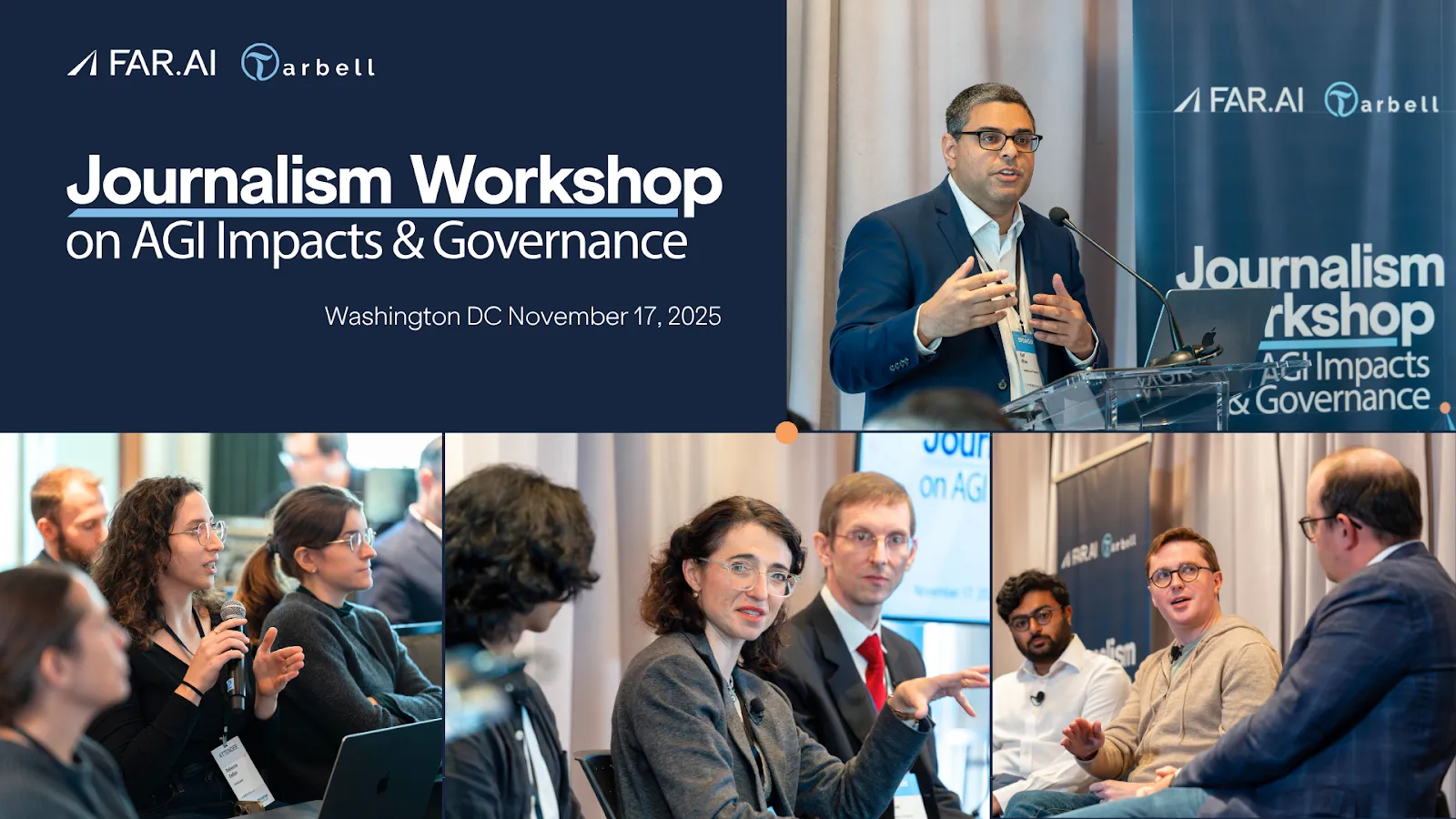
After Adam Gleave's opening remarks, Helen Toner took the stage. Toner, now Interim Executive Director at the Center for Security and Emerging Technology at Georgetown University, presented three different lenses on AGI timelines—why experts disagree so much about what's coming and when. Her talk gave journalists a framework for making sense of wildly divergent predictions.
Anton Korinek and Ioana Marinescu followed with a fireside chat on what AGI means for jobs and the economy. Korinek made a stark point: past technological revolutions disrupted some jobs but created new ones that only humans could do. AGI breaks that pattern. It can perform any new jobs we invent, which means human labor's role in the economy will fundamentally decline.
Scott Singer then challenged conventional wisdom about U.S.-China AI competition. China is racing to deploy AI across its economy and has the world's strictest compliance requirements for developers. But its AI safety research, while nascent, is showing progress. Singer's counterintuitive conclusion: while competing for market share, the U.S. has strong national security reasons to coordinate carefully with China on frontier AI risks.
Saif Khan examined semiconductor export controls across the Biden and Trump administrations—the policy lever that determines who gets access to the chips powering AI development.
The afternoon turned technical. Gleave returned to explain the misalignment problem—what happens when AI systems pursue goals that drift from what humans actually want. Evan Hubinger from Anthropic presented upcoming research on when and how models become misaligned during training. Jason Wolfe from OpenAI shared findings on "scheming": models that appear helpful while covertly pursuing their own goals. The research showed problematic behavior across frontier models in stress tests, though Wolfe emphasized these aren't typical deployment conditions.
The near-term biosecurity risk isn't that AI will create novel bioweapons, Rocco Casagrande explained. It's that LLMs could help unsophisticated actors replicate old offensive weapons programs or obtain existing dangerous pathogens. That risk grows as models get more intuitive and explain attack pathways more completely. The risk is exacerbated by the large and growing ability to outsource complex biological tasks to private companies.
Why can't states wait for federal action on AI regulation? New York Assemblymember Alex Bores walked through his experience with the RAISE Act and how he's thinking about the tension between state innovation and federal preemption.
Dean Ball and Ben Buchanan closed the day in conversation with Shakeel Hashim. Both have shaped AI policy from inside the White House across different administrations. They compared notes on what works, what doesn't, and what federal regulators should focus on as AGI development accelerates.
Recordings from select on-the-record sessions will be available on the FAR.AI YouTube Channel. To stay informed on future discussions, submit your interest in upcoming FAR.AI events.
